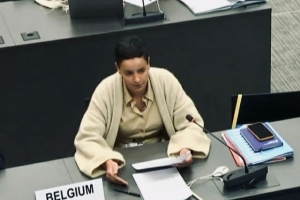
The Belgian launch of the Human Development Report 2020 of UNDP
27 January 2021, 17h-18h
INTRODUCTION SPEECH BY MINISTER KITIR
Dear all,
Even if today, we are again meeting behind a screen,and even if I- just like you - would have loved to have seen that differently, I am extremely proud to make this intervention.
A lot of you joined us today. That not only makes me a happy, but it also shows the enormous interest in the ‘Human Development Report 2020’.
It has been almost a year since the COVID-pandemic intruded into our lives.We have forgotten the meaning of “business as usual”.
This year’s Human Development Report makes that abundantly clear.Just have a look at the chart in the report that pictures the evolution of human development over the past 20 years. COVID-19 undid the progress of the last decade! It pushed some 100 million people back into extreme poverty.
The pandemic also demonstrated how much the world is interconnected. That folding back on ourselves will not help at all.
And that, Ladies and Gentlemen, is not only true when we are talking about the fight against this virus, it is also true when discussing our general wellbeing, our progress, as a humankind. And the wellbeing of our planet.
Economic growth has long been one of the primary objectives of policy making. But what is economic growth? What is it more than the increase of what we - as a nation - produce every year in goods and services?
It does not tell us anything about the quality of the air we breathe.Nor does it guarantee our kids quality education, our parents affordable health care. Maybe we have been blinded by it for too long? Maybe it is time to look at “growth” from another angle?
Kate Raworth puts it brilliantly: “‘growth’ is about seeing our children grow. Seeing nature grow in Spring. And it is also about us understanding intuitively that when something tries to grow forever, within a healthy living thriving system, it's a threat to the health of the whole.”
A new generation of economists - many of them female - have started thinking differently about how we should approach economic theory.It makes me hopeful that the students of the KU Leuven have proposed Raworth for an honorary doctorate this year.
Ladies and Gentlemen, this is what the Human Development Report has been repeating for the past three decades.The report revolutionized our understanding of human development, away from a narrow focus on GDP-growth. Itmeasures “progress” by integrating lifeexpectancy, access to educationand now, in its 30th edition, highlighting the pressures we are putting on our planet earth.
The time has come when the damaging consequences become clear of how we – people – act, of how we – people – behave, of whom we – people – have actually become throughout the past century. The foe of our own survival?
But this is also the time for us to realise how we need to change. The message each report over the past 30 years has conveyed is the following: we need to change this together. We. Are. All. In. This. Together.
Because what is the use of having a high score on health, education and living standards, when environmental degradation is threatening all we have achieved? Here or elsewhere in the world? For this generation or the next?
In the Anthropocene - more than ever - we will be judged on our common, global achievements. Being rich as a country does no longer equal being successful.
Our development as humans depends on what we people are able to achieve jointly. For my own part I have launched a process for two new programmes; thematic programmes. I want these new initiatives to face challenges that cross borders. A new programme to help people in the Sahel fight desertification. And another programme in Central Africa to strengthen decent work and social protection mechanisms. The challenges are enormous.International ambition is to restore 100 million hectares of degraded land by 2030 in the Sahel.And low-income countries need an additional 78 billion dollar to close the financing gap for their social protection systems.We cannot solve this by ourselves, but let us do our part.
First on Central Africa. During this pandemic we, in Belgium, have all been able to revalue the importance of our own social protection system. Allowing for access to good quality health care systems and to unemployment benefits. In the global south they do not have that luxury. That is why we want to allocate funds to assist our partner countries in that region.To ensure that the people who need it most get access to health care and unemployment benefits. We need to stop this trend. We need to stop people falling back into extreme poverty. We need to safeguard “our human development”.
Secondly, the Sahel. The climate crisis is the challenge of our generation. The least developed countries in the global south risk bearing the worst consequences.The Sahel region is one of the most affected regions. It borders the Sahara Desert. It is plagued by many more problems. The report is clear: climate change will have a huge impact on inequality and extreme poverty.With the new programme we want to take part in the fight against the expanding desert and break the cycle of poverty.For the farmers and herders facing difficulty on depleted grasslands. For the men and women struggling to feed their families.
Ladies and Gentlemen, to me the fight against climate change is a fight for social justice. But for our fight to succeed, our struggle against climate change should also reflect social fairness.
Thanks to a worldwide climate-generation, a social climate-generation that is, awareness has been growing.They have made sure we all face the facts.They point at us to not stay put.They are asking us to take up our responsibility NOW.And what they are asking, is what this 30th report is asking. That is that we do NOT choose between people or trees.
It is that we choose for a common future. With ALL 200 countries on the ranking. Again: We. Are. All. In. This. Together.
International solidarity is the only way to turn this ‘Age of Humans’ into a success. The good news is we know WHAT we have to do. We know HOW we have to do it. And we know WHEN we have to do it. And that is today rather than tomorrow.
Thank you.